Low-Moisture Extraction vs. Steam Cleaning vs. Dry Foam: Which Is Best for Your Furniture?
“Steam cleaning” is often used as a catch-all term for upholstery cleaning, but different methods do different jobs. Low-moisture cleaning, dry foam, deep extraction and high-heat steam each have different uses, especially when dealing with delicate fabrics, heavy dirt or stubborn stains.
First: Steam and Extraction Are Not the Same
The biggest misunderstanding is treating steam cleaning and extraction as interchangeable.
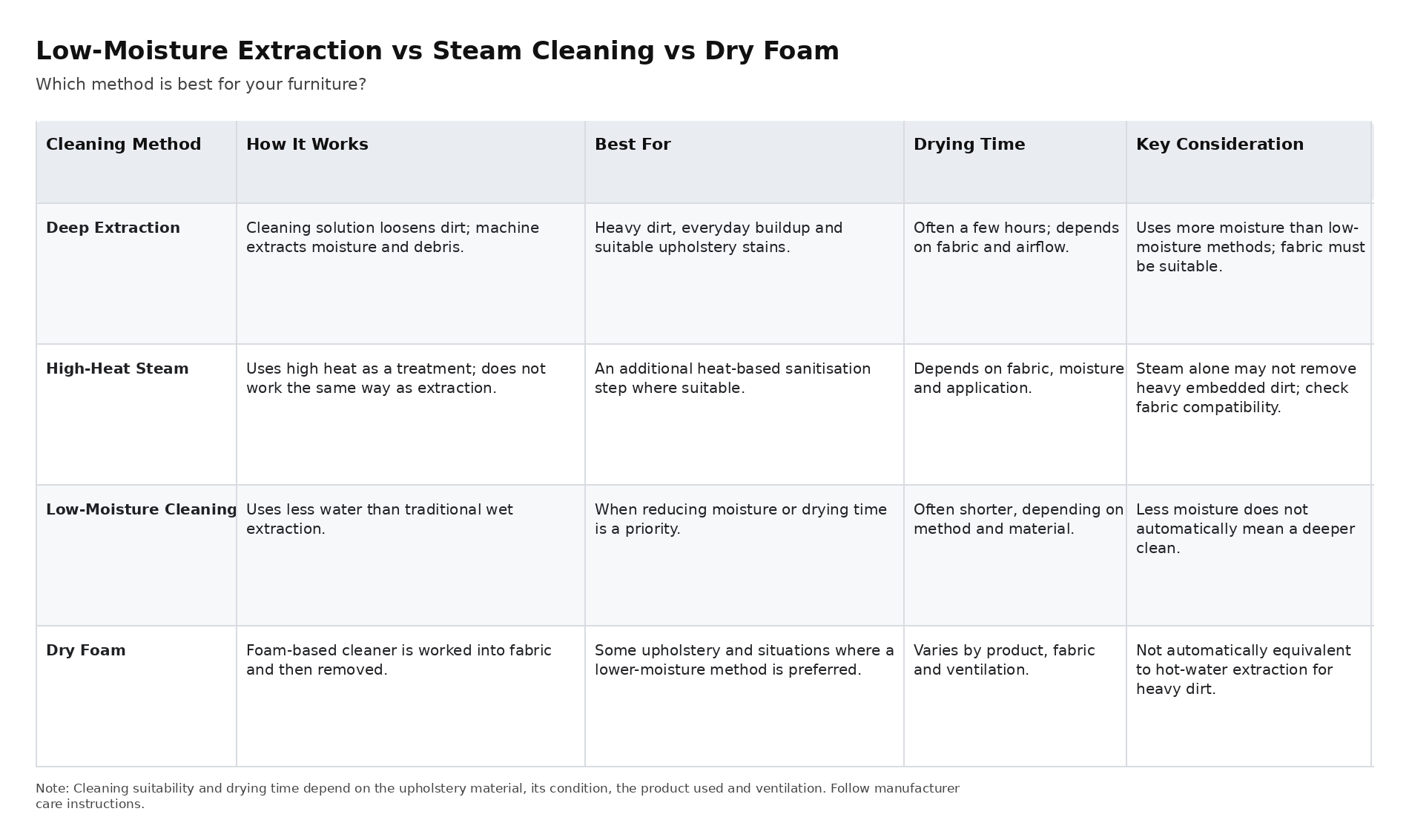
Extraction uses a cleaning solution to loosen dirt before a machine removes the solution, moisture and loosened debris from the upholstery.
Steam uses high heat to treat the surface and fabric.
They can be used together, but they aren't performing exactly the same function.
StandByBed's standard deep-cleaning process uses shampoo injection and extraction, with high-heat steam sanitisation available as an additional treatment.
Deep Extraction: Best for Built-Up Dirt
If a sofa has accumulated sweat, dust, food residue, pet-related buildup or visible stains, extraction is generally the more relevant method.
The cleaning solution is worked into suitable upholstery before the loosened dirt and moisture are extracted.
This is particularly useful for heavily used sofas and furniture that hasn't had a proper deep clean for an extended period.
The result is also easier to demonstrate: the extracted water can show how much material was removed from the fabric.
Steam Cleaning: Best as a Heat-Based Treatment
Steam works differently.
High-temperature steam can be used as part of a sanitisation process, particularly where reducing microorganisms and allergens is a priority.
But steam alone isn't necessarily the best solution for heavily soiled upholstery.
If the problem is a large amount of dirt physically sitting inside the fabric, extraction is designed specifically to remove that loosened material.
This is why combining deep extraction with high-heat steam can make sense when the fabric is suitable.
Low-Moisture Cleaning: When Drying Time Matters
Low-moisture cleaning uses significantly less water than traditional wet extraction.
This can be useful when working with materials that are sensitive to moisture or when reducing drying time is a priority.
Some Singapore cleaners specifically position low-moisture cleaning for delicate materials such as velvet, suede and microfibre.
However, “less moisture” doesn't automatically mean “deeper clean.”
The right choice depends on what is actually inside the upholstery and how much moisture the material can safely handle.
What About Dry Foam?
Dry-foam cleaning works by applying a foam-based cleaning product that is agitated through the upholstery before being removed.
It is another lower-moisture option, but it should not automatically be treated as equivalent to hot-water extraction.
If the main issue is heavy embedded dirt, you want to know whether the cleaning process is actually removing that material or primarily treating the surface.
There isn't one method that's best for every sofa.
The fabric matters just as much as the level of dirt.
Velvet, for example, has a pile that can change appearance or texture when handled incorrectly. Natural fibres such as linen and cotton can also be more sensitive to excessive moisture.
What StandByBed Uses
StandByBed's standard upholstery deep-cleaning process starts with an inspection and pre-treatment, followed by deep cleaning and extraction. The process then includes vacuuming and drying, with most items expected to dry within 2–4 hours with good airflow.
High-heat steam is available as an optional $10-per-item add-on.
That distinction matters because a customer looking for “steam cleaning” may actually need deep extraction if the main problem is accumulated dirt or staining.
Don't Choose a Method Based on the Name Alone
“Steam cleaning,” “deep cleaning,” “dry foam” and “low-moisture cleaning” can sound similar when you're comparing websites.
Instead, ask:
- What happens to the dirt?
- How much moisture is being used?
- Is the solution extracted afterwards?
- Is steam included or an add-on?
- Is the method suitable for my fabric?
The best upholstery cleaning method isn't the one with the most impressive name.
It's the one that matches the fabric, condition and cleaning problem.